The Canine Oncology Visit: 15 Questions That Lead to Better Decisions
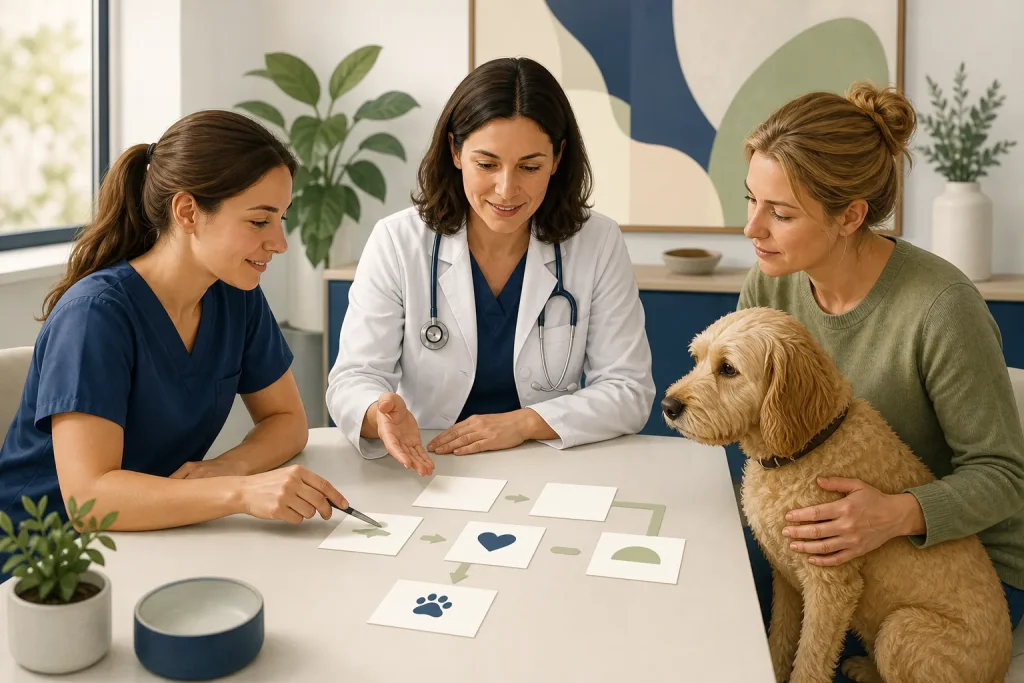
An oncology consultation can compress unfamiliar science, strong emotion, and major decisions into one room. You do not need to remember every word or decide everything immediately. Your job is to understand the problem, the realistic options, and how each option fits your dog and family. AAHA’s 2026 communication guidance supports a contextual conversation that includes benefits, burdens, costs, expected and unexpected outcomes, and client priorities.
Before the appointment
Ask the specialty hospital which records it already has. Bring pathology and cytology reports, laboratory results, imaging reports and images when available, surgery notes, medication history, allergies, and a list of every supplement. Write a short timeline of when signs began and what has changed. Decide who will take notes. Ask whether recording the conversation is permitted.
Also write three family priorities. Examples might be preserving comfortable walks, minimizing hospital travel, obtaining the strongest local control, avoiding treatments that require frequent sedation, or staying within a defined budget. Priorities are not a test of devotion; they are clinical context.
Questions about what is known
- What is the exact diagnosis, and which test established it?
- How confident is that result? Ask whether more tissue, special staining, or pathology review could change it.
- Do grade and stage apply to this tumor? If so, which are known and which are still uncertain?
- What does the imaging show—and not show? No visible spread is reassuring but does not necessarily exclude microscopic disease.
Questions about the next test
- What decision will this test change?
- What are the burdens? Include fasting, sedation or anesthesia, discomfort, risk, travel, cost, and turnaround time.
- Is there a reasonable narrower workup? Ask what information would be lost and whether that matters to the options you would consider.
Questions about each care option
- What is the goal? Cure, durable local control, slowing disease, relieving a symptom, or gathering information are different goals.
- What are the best, typical, and worst plausible outcomes? Ranges are usually more honest than a single survival number.
- What does treatment look like week to week? Ask about visits, hospitalization, anesthesia, home handling, monitoring, and recovery.
- What adverse effects are common, serious, and urgent? Request written thresholds and after-hours contact details.
- How will we know whether it is helping? Define the examination, measurement, imaging, laboratory value, or comfort goal and the review date.
- What happens if we stop or change course? A plan should include off-ramps when burden exceeds benefit.
Questions about the whole family
- What is the estimated total cost and where is uncertainty greatest? Include supportive medicines, rechecks, tests, emergencies, and travel.
- What would comfort-focused care look like now? Palliative care is not reserved for the final day and may accompany tumor-directed treatment.
Translate statistics carefully
Published response rates and median survival times describe groups, not an individual promise. Ask whether the cited data match your dog’s tumor subtype, grade, stage, prior treatment, and overall health. A median is not an expiration date. Also ask what quality of life was observed and how often serious adverse events occurred, not only how long animals lived.
Close the visit with a teach-back
Say, Let me check that I understood, then summarize the diagnosis, next step, goal, major risk, home-monitoring threshold, and contact plan in your own words. Invite correction. Ask for a written summary and copies of new reports. If you need time, ask which decision is time-sensitive and what a safe decision window is.
If your goals change
Plans can be revised. A dog may respond differently than expected, another illness may emerge, or the practical burden may change. Tell the team early. Good shared decision-making does not require pursuing every available intervention; it requires aligning medically reasonable options with comfort and informed family values.
Medical disclaimer: This article is an educational conversation aid, not medical advice or a recommendation for or against any cancer treatment. Only a veterinarian who has examined your dog and reviewed the diagnostic record can discuss appropriate options and urgency.
Sources and further reading
- AAHA: Client Communication in Oncology
- FDA: Questions to Ask When a Dog Has Cancer
- UC Davis Veterinary Oncology Service FAQ
