A Five-Minute Weekly Weight and Muscle Check for Dogs in Cancer Care
A dog can finish meals and still lose weight or muscle, while a dog with fluid accumulation may appear stable on the scale. Tracking the same few measurements under similar conditions helps the veterinary team recognize a meaningful trend instead of reacting to one noisy value.
Why this deserves a plan
Nutrition screening is part of oncology care from diagnosis through follow-up. Muscle over the head, spine, shoulders, and pelvis can decline separately from fat. Early change may prompt review of actual intake, nausea, pain, swallowing, digestion, treatment effects, and other disease before weakness becomes obvious.
Prepare before the stressful moment
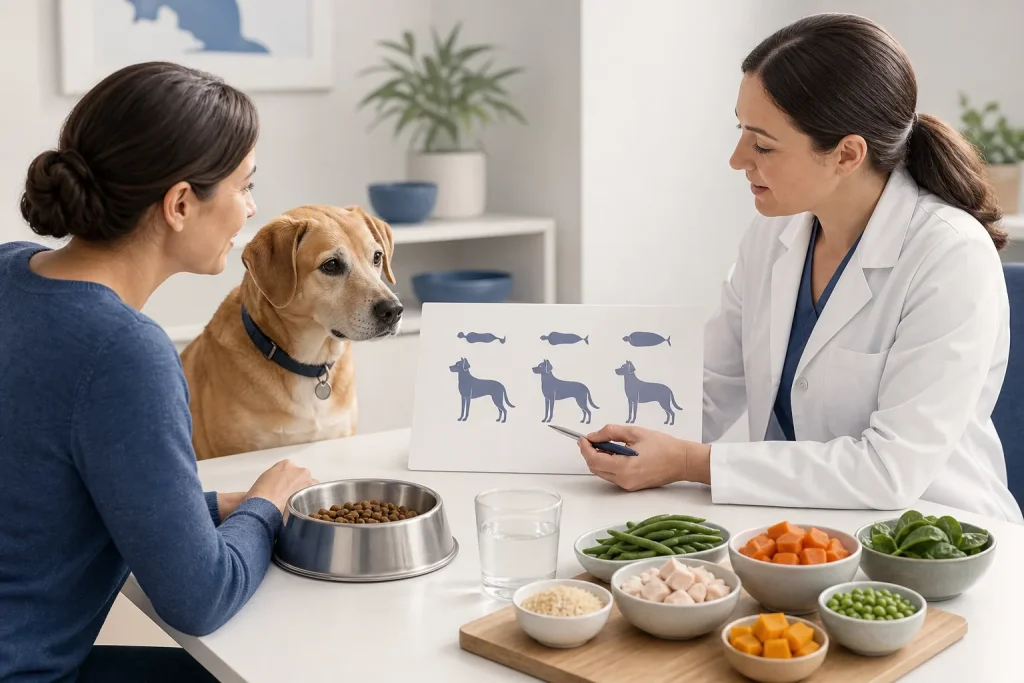
Ask the clinic to show you body-condition and muscle-condition scoring for your dog. Use the same reliable scale when available, at a similar time relative to meals and elimination. Choose a weekly schedule rather than weighing repeatedly during an anxious day. Keep photos at the same angle and distance.
What to observe and record
Record weight, appetite as amount consumed, food and treat totals, vomiting, stool, activity, and one brief note on visible or palpable muscle. Note belly enlargement, swelling, dehydration, or fluid therapy because these can distort scale interpretation. Bring the log to rechecks and ask the team to verify technique.
When to call or escalate
Rapid weight loss, progressive muscle wasting, prolonged poor intake, repeated vomiting, swallowing difficulty, marked weakness, abdominal distension, or new swelling deserves prompt review. A stable number with declining function or intake still matters. The dog’s comfort and ability to eat safely take priority over hitting a target.
What not to improvise
Do not chase the scale with high-fat scraps, raw meat, unbalanced recipes, or multiple supplements. Do not force exercise to rebuild muscle before pain, bone stability, blood counts, and medical clearance are addressed. A nutrition plan should accommodate the tumor and concurrent disease.
Use photographs to preserve the baseline
A scale cannot show where tissue has changed. At the start of tracking, ask the veterinary team to identify the landmarks they use for body-condition and muscle-condition assessment. With the dog standing comfortably, take repeat photographs from the same side and above, using similar lighting, distance, and posture. Do not pose or restrain a painful dog simply to complete the record.
Review the image series together with weight, measured intake, activity, and any abdominal or limb swelling. A fuller abdomen can coexist with loss over the spine or head, and a stable scale can conceal that contrast. The record is most useful when it triggers a specific question—whether nausea, pain, swallowing, diet adequacy, fluid change, or reduced mobility needs attention—rather than when owners assign a body score without confirmation. A clinician can also decide when a nutrition or rehabilitation referral would add value.
Take these questions to the care team
- Are body condition and muscle condition changing differently?
- How much complete diet is actually consumed?
- Could fluid be masking a trend?
- What treatable cause limits intake or activity?
- When is nutrition or rehabilitation referral appropriate?
Medical disclaimer: This article is educational and cannot diagnose, treat, or determine prognosis for an individual dog. It does not replace an examination or an individualized plan from a licensed veterinarian.
Sources and further reading
- AAHA: Supportive and Symptomatic Care
- WSAVA: Global Nutrition Guidelines
- WSAVA: Global Nutrition Toolkit
- Brunetto et al.: Nutrition and Oncology in Dogs and Cats
