Canine Soft Tissue Sarcoma: Why the First Surgery Needs a Plan
Overview
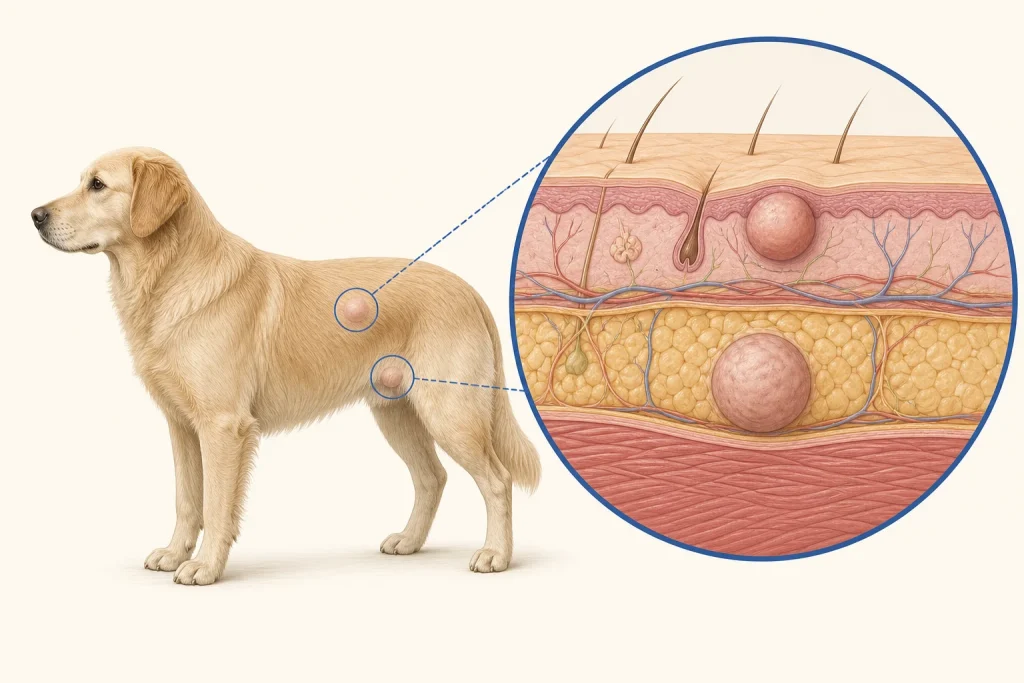
Soft tissue sarcomas are a biologically related group of mesenchymal tumors. They often form a firm mass under the skin and tend to infiltrate locally; metastatic risk varies with tumor subtype and histologic grade.
Common signs
A persistent soft or firm subcutaneous mass that may be movable early and fixed later. Growth can be slow or faster. Large or strategically located tumors may cause pain, altered gait, skin breakdown or reduced function.
Common locations
Skin and subcutaneous tissues of the trunk and limbs are common, but sarcomas can arise in deeper muscle or connective tissue throughout the body.
Diagnosis discussion
Fine-needle aspiration may be nondiagnostic because these tumors can shed few cells. A core or incisional biopsy is often useful before definitive surgery. CT or other imaging may map deep margins. Histopathology supplies subtype, grade and sampled margin information.
Urgency and when to contact a veterinarian
Schedule a prompt appointment for any persistent or growing mass. Earlier reassessment is warranted for rapid change, pain, ulceration, bleeding, fixation to deeper tissue or interference with movement.
Treatment discussion
Wide planned excision is a main local-control approach. Radiation can be considered for incompletely excised, unresectable or selected preoperative cases. Chemotherapy may be discussed for higher-grade or metastatic-risk tumors. Options depend heavily on location and pathology.
Home monitoring
Measure and photograph the mass on a fixed interval. Record mobility, firmness, skin condition, pain and effect on normal activity. After treatment, inspect the surgical area and nearby tissue and attend scheduled local and chest rechecks.
Questions to ask your veterinarian
- Could an unplanned excision make a later definitive surgery harder?
- Should we obtain a biopsy or CT before choosing surgical margins?
- What do the grade and measured margins mean for local recurrence and metastasis?
- Would radiation or systemic therapy add meaningful benefit in this case?