Canine Nasal Tumors: Persistent One-Sided Nasal Signs Need Imaging
Overview
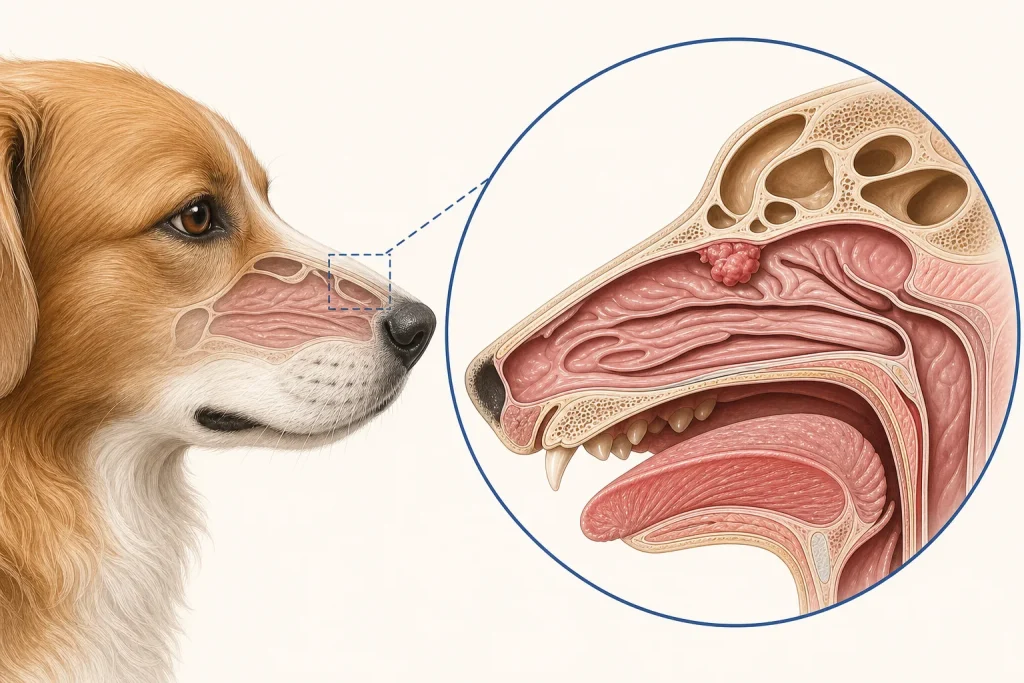
Canine nasal tumors arise inside the nasal cavity or nearby sinuses. Early signs can resemble dental disease, infection, inflammation, or a foreign body, so a tumor cannot be identified from discharge or a nosebleed alone.
Common signs
Repeated discharge from one nostril, blood from the nose, noisy airflow, sneezing, pawing at the face, reduced appetite from loss of smell, facial asymmetry, or an eye that appears displaced can prompt investigation. The pattern and progression matter more than any single sign.
Common locations
The nasal passages and paranasal sinuses are the main sites discussed here. Disease can extend locally toward the orbit, hard palate, cribriform plate, or regional lymph nodes, which is why cross-sectional imaging is often central to planning.
Diagnosis discussion
The veterinarian may begin with oral and nasal examination, bloodwork, and imaging. CT is commonly used to map local extent and plan rhinoscopy or biopsy. Tissue examination is required to name the tumor; imaging alone does not supply a histologic diagnosis.
Urgency and when to contact a veterinarian
Contact a veterinarian promptly for recurrent one-sided discharge or any unexplained nosebleed. Labored breathing, uncontrolled bleeding, collapse, marked weakness, or sudden neurologic change warrants urgent or emergency assessment.
Treatment discussion
Options may include radiation therapy, surgery in selected cases, systemic therapy for selected tumor types, or comfort-focused care. Goals, likely local control, anesthesia burden, travel, cost, and the dog’s overall health should be discussed before choosing a plan.
Home monitoring
Record which nostril is affected, discharge color and frequency, breathing effort, appetite, sleep, facial symmetry, bleeding episodes, and prescribed medication effects. Do not place drops or instruments in the nose unless the treating veterinarian directs it.
Questions to ask your veterinarian
- What imaging best defines the affected area before biopsy?
- How will a tissue sample be obtained and what are the anesthesia considerations?
- Which findings would change the radiation, surgery, or comfort-care plan?
- What amount of bleeding or breathing change should trigger emergency care?