Treatment, Medication & Supplement Directory
A comprehensive encyclopedia of medicines, chemotherapy protocols, targeted and immune therapies, supplements, Chinese herbal formulas, Traditional Chinese Veterinary Medicine (TCVM) approaches, and supportive-care options used or discussed in canine and feline tumor care. Directory entries explain what each option is, where it may fit, its evidence and safety boundaries, and what to discuss with a veterinarian; they are references, not individualized prescriptions or rankings.

Multimodal Pain Management in Canine Cancer Care
Multimodal pain management combines approaches that act at different points in the pain pathway and addresses both the tumor and its functional consequences. A plan may include prescriptions,…
Read more
Cyclophosphamide in Cancer Protocols: Bladder and Marrow Safety
Cyclophosphamide is an alkylating chemotherapy used in selected veterinary protocols, with blood-count, urinary, gastrointestinal, and household-safety considerations.
Read moreMelphalan in Veterinary Oncology: Cumulative Marrow-Risk Discussion
Melphalan is an alkylating antineoplastic medicine used in selected veterinary cancers and requires individualized blood-count, gastrointestinal, and handling plans.
Read more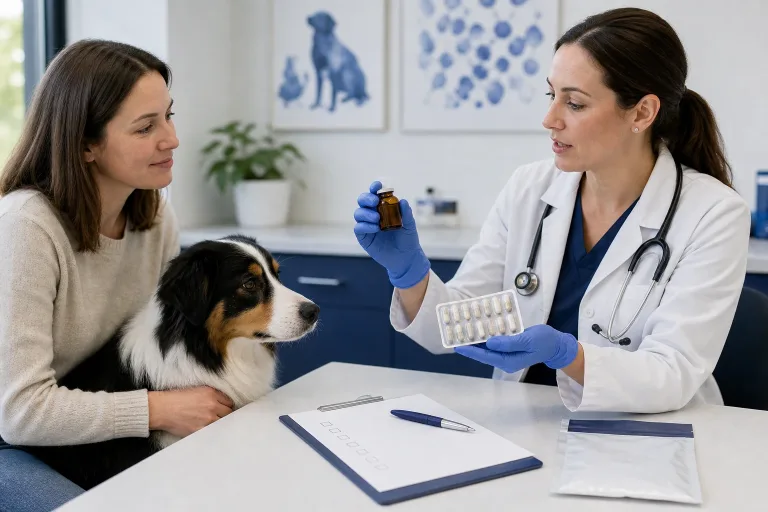
Home Handling of Oral Chemotherapy and Patient Waste
Families need drug-specific written instructions for receiving, storing, administering, cleaning, laundering, and disposing of chemotherapy and contaminated patient waste.
Read more
Maropitant for Nausea and Vomiting Support in Cancer Care
Maropitant is a prescription antiemetic used for selected dogs and cats, but controlling vomiting does not identify or resolve every cause of nausea or gastrointestinal disease.
Read moreOndansetron for Persistent Nausea: Role and Interaction Review
Ondansetron is a serotonin-receptor antiemetic used by veterinarians for selected nausea and vomiting, often when one pathway or medicine is not enough.
Read moreMetoclopramide: Antiemetic and Motility Questions in Oncology
Metoclopramide has antiemetic and upper-gastrointestinal motility effects, making obstruction, neurologic history, cause, route, and interactions central to safe selection.
Read moreOpioids in Veterinary Cancer Pain and Crisis Care
Opioids are controlled prescription analgesics used in selected acute, severe, perioperative, and palliative pain plans under route-, product-, and jurisdiction-specific oversight.
Read moreNamed profile Acid-Suppression Medicines in Veterinary Oncology: Rational-Use ProfileRepresentative category illustration – no product packaging is shown.Acid-Suppression Medicines in Veterinary Oncology: Rational-Use Profile
proton-pump inhibitors and histamine-2 receptor antagonists is covered as gastrointestinal supportive-medicine class, with species, evidence, regulatory, safety, interaction and monitoring boundaries for a veterinarian-led decision.
Read more Named profile Cobalamin (Vitamin B12) in Canine and Feline Oncology SupportRepresentative category illustration – no product packaging is shown.
Cobalamin (Vitamin B12) in Canine and Feline Oncology Support
cobalamin (vitamin B12) is covered as nutrient replacement for documented or strongly suspected deficiency; not a universal cancer supplement, with species, evidence, regulatory, safety, interaction and monitoring boundaries…
Read more Named profile H1 and H2 Blockade Around Mast-Cell Degranulation RiskRepresentative category illustration – no product packaging is shown.
H1 and H2 Blockade Around Mast-Cell Degranulation Risk
H1-receptor and H2-receptor blocking companion medicines is covered as protocol-linked supportive medicines; not direct antitumour treatment, with species, evidence, regulatory, safety, interaction and monitoring boundaries for a veterinarian-led…
Read more