Canine Histiocytic Sarcoma: Confirm Lineage and Separate Localized From Disseminated Disease
Summary
Histiocytic sarcoma can mimic other round-cell, pleomorphic, inflammatory, or mesenchymal diseases; morphology, immunophenotype, anatomic pattern, and staging must support the label.
Article
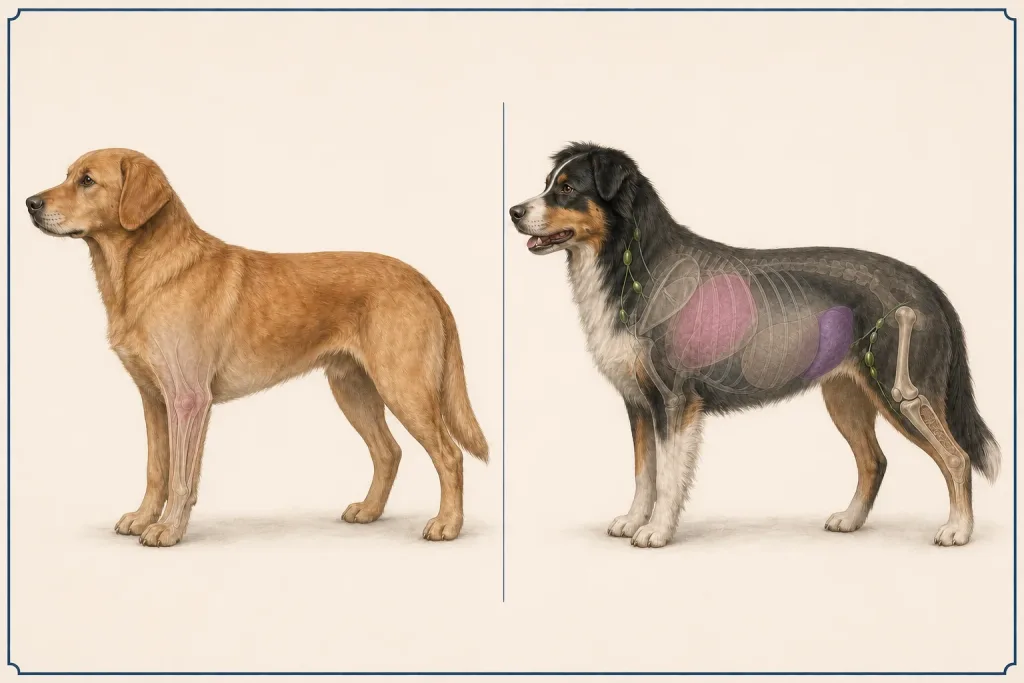
Evidence-informed clinical review. Histiocytic sarcoma may arise as a localized mass or appear at multiple sites, including organs, lungs, bone, joints, or periarticular tissue. The term describes cellular lineage and malignant behavior, but it should not be applied from breed, site, or cytologic impression alone when important mimics remain.
The clinical question
The pathologist and oncologist need to determine whether morphology and marker expression support histiocytic differentiation, whether the sampled lesion is representative, and whether disease is localized or disseminated. That distinction affects the relative roles of local treatment, systemic treatment, and symptom-focused care.
What current evidence can establish
Cytology can raise strong suspicion in some cases, while histopathology provides architecture and may support a broader immunohistochemical panel. Marker interpretation must include appropriate controls and morphology because no isolated stain is perfectly specific. CBC, chemistry, regional-node assessment, thoracic and abdominal imaging, and site-directed tests help define distribution.
A decision-focused pathway
Send complete history, lesion map, imaging, prior pathology, and breed information without allowing breed to become the diagnosis. Ask the laboratory which differentials the panel addresses and what uncertainty remains. If only one lesion is found, stage before assuming local behavior and document exactly which sites were assessed.
Surgery or radiation may be discussed for selected localized disease, while chemotherapy may enter both localized and disseminated plans. Functional impact, pain, marrow or organ involvement, and pace of change matter alongside scan findings. A recheck plan should identify which lesions, laboratory changes, and symptoms will be tracked.
Evidence gaps and interpretation
Most outcome evidence comes from retrospective series with mixed primary sites and treatments. Breed predisposition changes prior probability but not tissue identity. Apparent localization is limited by test sensitivity, and an immunophenotype must be interpreted within the panel used. Emerging molecular ideas should not be presented as established clinical benefit.
Safety, monitoring, and escalation
Rapid respiratory decline, collapse, severe lameness, neurologic change, bleeding, or marked systemic illness needs prompt evaluation. Biopsy approach and anesthesia risk depend on lesion site. Immunosuppressive or anticancer medication given before diagnostic sampling may affect results and should be coordinated with the diagnostic team.
Lineage confirmation comes before distribution labels
Histiocytic sarcoma can arise in different anatomic sites and can be localized or disseminated at recognition. Cytologic appearance may raise suspicion, but lineage often requires integration of morphology with immunophenotyping and the pathologist's assessment of sample quality. The report should state what is confirmed, what remains a differential, and whether additional tissue would materially change classification.
Once identity is sufficiently supported, staging maps the primary site, regional nodes, lungs, abdominal organs, bone or marrow as clinically relevant. That distribution affects how local and systemic options are framed, but a negative staging study cannot guarantee absence of microscopic disease. Reassessment should use the same target lesions and clinical endpoints where possible so that a new mass is not automatically called progression without checking whether it represents the same process.
Questions for the veterinary team
- Which morphologic and marker findings support the diagnosis?
- What important mimics remain?
- How was localized versus disseminated disease assessed?
- What is the measurable goal of each treatment option?
- Which symptom or laboratory change requires urgent review?
Medical disclaimer: This article is educational and cannot diagnose, treat, or determine prognosis for an individual dog. It does not replace an examination or an individualized plan from a licensed veterinarian.