Canine Multiple Myeloma: Connect Monoclonal Protein With Marrow and Organ Effects
Summary
A monoclonal protein is an important clue, not a complete diagnosis; marrow or tissue findings, skeletal disease, blood counts, kidney status, calcium, viscosity-related signs, and serial measurement belong together.
Article
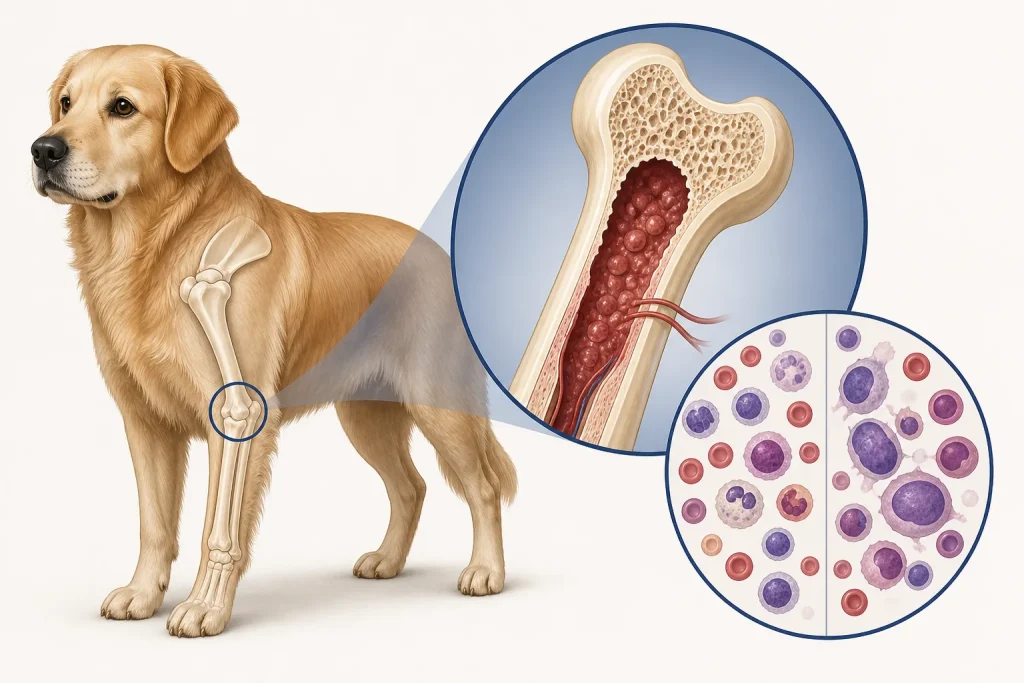
Evidence-informed clinical review. Multiple myeloma is a plasma-cell neoplasm that may affect marrow, bone, kidneys, blood viscosity, immunity, and other organs. Dogs can reach the workup through anemia, protein abnormalities, pain, recurrent infection, bleeding, neurologic or ocular signs, or incidental laboratory findings. No single electrophoresis result captures the whole syndrome.
The clinical question
The diagnostic task is to establish whether an abnormal protein is truly monoclonal, determine whether neoplastic plasma cells are present in marrow or another site, and document clinically important organ effects. The monitoring task is to choose measurements that reflect both disease burden and the dog’s function.
What current evidence can establish
Serum protein electrophoresis can identify a restricted pattern, and immunofixation can characterize the immunoglobulin. CBC, chemistry, urinalysis, urine protein assessment, imaging, marrow evaluation, cytology, and histopathology address different diagnostic criteria and complications. Serial paraprotein measurement may support response assessment when interpreted with clinical and laboratory changes.
A decision-focused pathway
Confirm hydration and sample quality before overinterpreting total protein. Review anemia pattern, platelet and white-cell counts, kidney values, calcium, urine findings, pain location, infections, bleeding, vision, and neurologic status. Select skeletal imaging and marrow or lesion sampling according to the leading question rather than applying a single universal panel.
A treatment and supportive-care plan should state how response and toxicity will be measured. Tumor-directed therapy may be paired with pain control, management of kidney or viscosity complications, infection assessment, and mobility support. Trends should be reviewed together because protein concentration can change with hydration and organ injury can progress independently.
Evidence gaps and interpretation
Canine evidence is limited by uncommon disease, small cohorts, variable diagnostic criteria, and adaptation of some response concepts from human medicine. A monoclonal gammopathy can occur in conditions other than myeloma, while some plasma-cell neoplasms produce little measurable protein. One laboratory trend should not overrule the entire clinical picture.
Safety, monitoring, and escalation
Collapse, severe weakness, breathing change, acute neurologic or visual signs, uncontrolled bleeding, inability to walk, or marked dehydration requires prompt assessment. Kidney function and infection risk can affect medicines and procedures. Families should not use human supplements or pain relievers to address bone pain or protein abnormalities.
A monoclonal pattern must be connected to the whole case
Finding a monoclonal protein narrows the investigation but does not by itself document every criterion needed to classify secretory multiple myeloma. Interpretation brings together protein testing, blood counts and smear findings, marrow evaluation when indicated, imaging for skeletal disease, and evidence of organ effects such as renal dysfunction, altered calcium, anemia, bleeding, or infection susceptibility. Each component answers a different part of the diagnostic question.
Longitudinal assessment is clearest when the same laboratory method and units are used and when changes in the measurable protein are read beside clinical status and organ function. A falling value is not a complete welfare assessment, and a single fluctuation may reflect analytical or physiologic variation. The monitoring plan should define which findings represent response, stable disease, toxicity, or a need to re-evaluate the original classification.
Questions for the veterinary team
- What establishes plasma-cell neoplasia in this dog?
- Which organs are currently affected?
- Is marrow or lesion sampling needed?
- Which serial measure best reflects response here?
- What complication requires same-day or emergency contact?
Medical disclaimer: This article is educational and cannot diagnose, treat, or determine prognosis for an individual dog. It does not replace an examination or an individualized plan from a licensed veterinarian.