Reading a Veterinary Oncology Clinical Trial: Protocol, Welfare, and Alternatives
Summary
A clinical trial is designed to answer a research question; eligibility, randomization, welfare safeguards, costs, standard-care allowances, withdrawal, and non-trial alternatives belong in informed consent.
Article
Evidence-informed clinical review. Trial enrollment can offer structured access to an investigational intervention or observation program, but novelty is not evidence of benefit. A listing can become outdated, and a protocol that is scientifically important may still be a poor fit for one dog’s disease, travel tolerance, comorbidities, or family circumstances.
The clinical question
The family and study team should clarify the hypothesis, study phase and design, sponsor, oversight, eligibility, required diagnostics, treatment or control arms, randomization and masking, standard-care restrictions, expected visits and procedures, costs, compensation, data use, and what happens after withdrawal or completion.
What current evidence can establish
Veterinary oncology best-practice recommendations emphasize prospective review, scientific merit, trained personnel, informed owner consent, patient welfare, transparent conflicts, and adverse-event processes. Current AAHA guidance recognizes clinical research as part of advancing care while requiring an evidence-aware and individualized discussion.
A decision-focused pathway
Ask the primary veterinarian or oncologist to confirm the diagnosis and reasonable standard options before the trial decision. Obtain the complete consent document and schedule, not only a recruitment summary. Identify which procedures are research-only, who provides emergency care, which costs are covered, and whether records flow back to the usual clinic.
Consent should be an ongoing conversation. Families need a contact for new signs, a process for protocol deviations, and freedom to withdraw without losing ordinary veterinary care. The team should also address post-trial access, incidental findings, tissue and data storage, publication, and whether results will be shared.
Evidence gaps and interpretation
Enrollment does not mean recommendation, approval, efficacy, or access to the active arm. Early studies may focus on safety or feasibility rather than benefit. Small veterinary cohorts and heterogeneous cancers can limit conclusions. A promising mechanism or human result cannot substitute for canine clinical evidence.
Safety, monitoring, and escalation
Any adverse sign should follow the protocol’s contact pathway, with emergency care prioritized when the dog is unstable. Families should not conceal outside medicines or supplements to preserve eligibility. Travel, anesthesia, sampling, placebo or control assignment, and delayed standard care are burdens that must be discussed plainly.
Read consent as a map of choices, not an enrollment formality
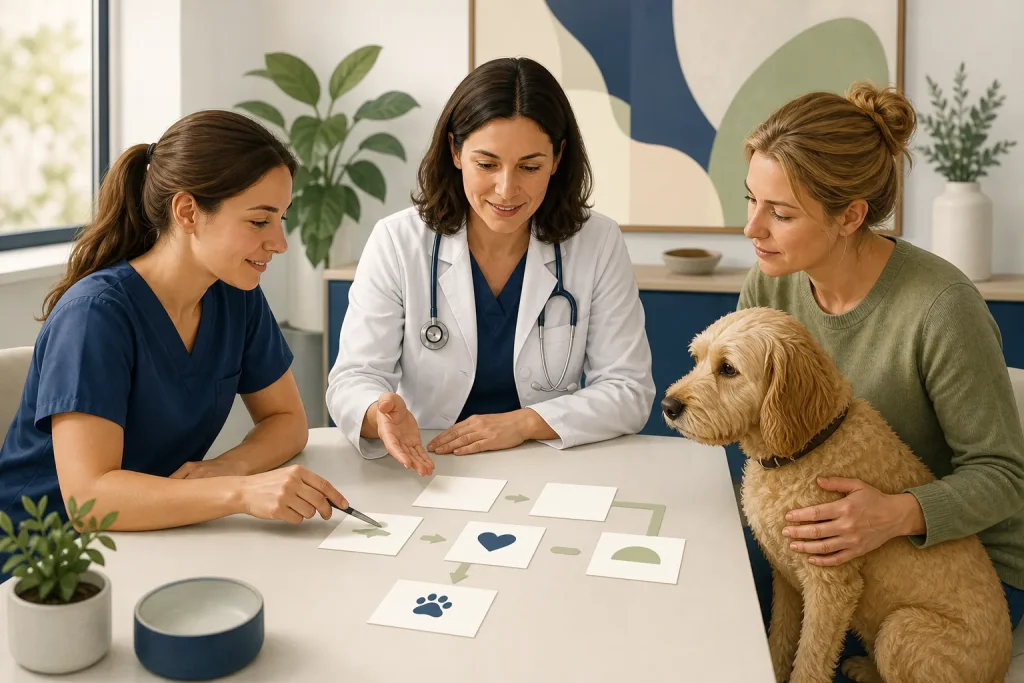
A clinical-trial discussion should identify the research question, eligibility tests, treatment allocation, required visits and samples, foreseeable burdens, costs, data use, and what care is provided for adverse events. Randomization or blinding, when present, needs a plain-language explanation. Participation does not guarantee access to the investigational treatment or a better outcome, and declining should not erase discussion of appropriate standard or palliative alternatives.
Welfare protections include monitoring rules, rescue care, withdrawal criteria, oversight, and the owner's right to leave the study. Families can ask which expenses continue after withdrawal and how new information will be communicated. A copy of the protocol summary and consent form supports later review with the primary veterinarian. Urgent clinical needs should be treated on their own timeline rather than postponed solely to preserve trial eligibility.
Questions for the veterinary team
- What research question and phase define this study?
- Which arm could the dog receive?
- What care is standard versus research-only?
- Who pays for complications and emergency care?
- What non-trial options remain if we decline or withdraw?
Medical disclaimer: This article is educational and cannot diagnose, treat, or determine prognosis for an individual dog. It does not replace an examination or an individualized plan from a licensed veterinarian.