Canine Thyroid Masses: Mobility, Vascular Invasion, and Treatment Planning
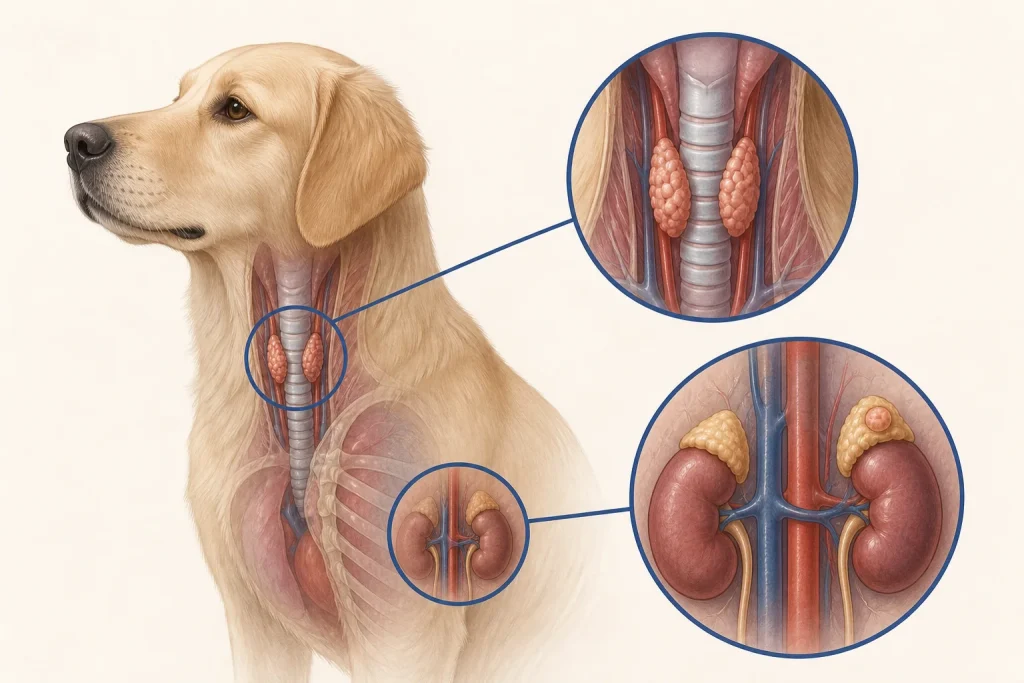
Summary
A thyroid-region mass requires more than a neck examination: tissue identity, hormone function, vascular relationships, metastatic assessment, and airway risk determine whether local treatment is feasible.
Article
Evidence-informed clinical review. Thyroid tumors in dogs can be mobile and discrete or fixed around vessels, nerves, trachea, and surrounding tissue. That distinction can change surgical complexity, but touch alone is not a complete staging method. A plan must connect the tissue diagnosis with cross-sectional anatomy, functional status, and the dog’s breathing and swallowing.
The clinical question
The central decision is whether a confirmed thyroid tumor can be approached safely for local control and what alternatives should be discussed if it cannot. The team also needs to determine whether the mass produces thyroid hormone, extends into major vessels, involves both glands, or has evidence of regional or distant spread.
What current evidence can establish
Ultrasound can characterize a cervical mass and guide selected sampling, while CT is often used to assess extent and vascular relationships. Microscopic examination establishes tumor identity. Blood testing supplies organ and hormone context but cannot classify a neck mass on its own. Thoracic imaging and other staging are selected for the planned decision.
A decision-focused pathway
Document voice change, cough, gagging, swallowing difficulty, heat intolerance, weight change, and respiratory signs. Review coagulation and sampling risk because thyroid tumors may be vascular. If surgery is considered, the surgeon should review imaging directly and plan for hemorrhage control, recurrent laryngeal nerve risk, parathyroid implications, and postoperative calcium or thyroid monitoring where relevant.
When complete removal appears unlikely, radiation, radioactive iodine in selected settings, systemic therapy, or comfort-focused management may enter the discussion. The words resectable and unresectable should be tied to a named imaging assessment and local expertise, not treated as universal properties of a tumor seen on a single scan.
Evidence gaps and interpretation
Outcome reports are influenced by tumor size, mobility, vascular invasion, metastatic status, completeness of local treatment, and case selection. Authorization and availability of radioactive or systemic options vary by country and center. No online description can identify which modality offers an acceptable balance for a particular dog.
Safety, monitoring, and escalation
Rapidly increasing neck swelling, noisy or difficult breathing, collapse, or inability to swallow needs urgent care. Biopsy and surgery can involve significant bleeding, airway, nerve, calcium, and endocrine risks. Families need a written plan for harness use, incision observation, voice or breathing changes, and timing of laboratory reassessment.
Mobility and vessel relationships change the planning problem
A thyroid-region mass may be freely movable, fixed to deeper tissues, or closely associated with major cervical vessels. Those findings do not establish histology, but they affect which imaging views and surgical questions are important. The examination should also record voice change, swallowing difficulty, coughing, breathing noise, cervical pain, and any cranial nerve abnormalities because functional effects can be as important as the measured diameter.
Cross-sectional imaging can map laterality, vascular contact or invasion, extension toward the thoracic inlet, regional nodes, and a route for tissue collection. Planning then separates three issues that are easily collapsed into one: what the mass is, whether its local anatomy permits the intended intervention, and whether staging identifies disease elsewhere. A pathology label cannot replace an anatomic map, and an impressive scan cannot replace tissue identity when that identity would change the options discussed.
Questions for the veterinary team
- Is the mass confirmed to be thyroid in origin?
- What does imaging show about vessels, airway, and fixation?
- Does hormone testing change anesthesia or treatment?
- What local-control options are realistically available here?
- Which postoperative changes require immediate assessment?
Medical disclaimer: This article is educational and cannot diagnose, treat, or determine prognosis for an individual dog. It does not replace an examination or an individualized plan from a licensed veterinarian.