Veterinary Electrochemotherapy: Match Accessibility, Histology, and Evidence
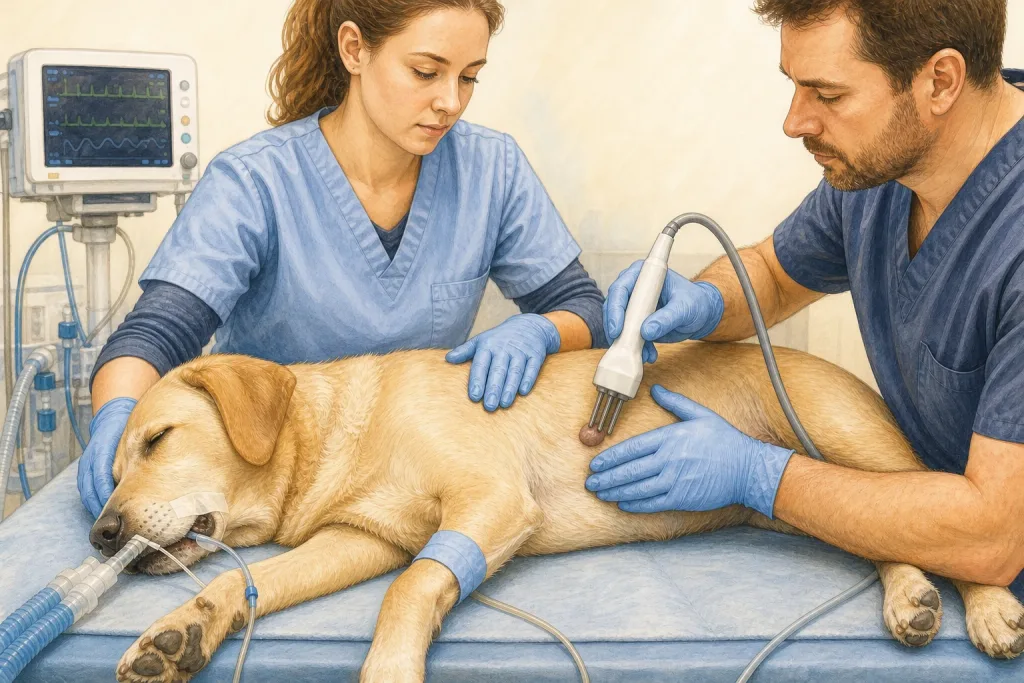
Summary
Electrochemotherapy combines electric pulses with a cytotoxic agent for local treatment; lesion accessibility, tissue diagnosis, electrode coverage, anesthesia, operator experience, and tumor-specific evidence matter.
Article
Evidence-informed clinical review. Electrochemotherapy temporarily changes cell-membrane permeability to increase intracellular exposure to selected agents in the treated field. It is a local modality, not systemic chemotherapy with electricity added. Suitability depends on the lesion’s location, depth, geometry, histology, prior treatment, and whether the complete target can be safely covered.
The clinical question
A consultation should clarify whether electrochemotherapy is proposed as primary, adjunctive, salvage, or palliative local treatment; what tissue diagnosis supports it; how the target and margins are defined; and what surgery, conventional radiation, systemic treatment, or comfort alternatives remain.
What current evidence can establish
Veterinary reviews and procedural guidance describe use in accessible superficial and oral tumors, but studies vary in tumor mix, technique, drugs, voltage parameters, response definitions, and follow-up. Evidence for one small superficial lesion should not be generalized to a deep, large, irregular, or metastatic tumor.
A decision-focused pathway
Confirm pathology and stage according to the tumor rather than the device. Review anticoagulants, organ function, anesthesia, implants, prior radiation, wound status, and nearby critical structures. Ask how electrode coverage is documented, whether more than one session may be needed, and how local response and toxicity will be assessed.
Electrochemotherapy may complement surgery or be considered when standard local options are limited, but it should not obscure metastatic risk. The team should explain expected swelling, pain, necrosis, wound care, cosmetic or functional change, and the availability of experienced follow-up if the treatment center is distant.
Evidence gaps and interpretation
The evidence base includes reviews, case series, and tumor-specific reports rather than a single standardized comparative program. A complete response in a selected cohort does not establish cure, and technical guidelines do not prove clinical advantage over surgery or radiation for every indication. Availability varies geographically.
Safety, monitoring, and escalation
Anesthesia, cytotoxic-drug exposure, electrical delivery, bleeding, swelling, tissue necrosis, infection, pain, and injury to adjacent structures are relevant risks. Families need hazardous-drug and wound instructions. Breathing or swallowing change, uncontrolled bleeding, severe pain, or rapidly expanding swelling warrants urgent contact.
Accessibility is necessary but not sufficient
Electrochemotherapy requires a lesion that can be reached and treated with an appropriate electrode geometry, but visibility or accessibility alone does not establish suitability. Histology, lesion size and depth, margins, nearby sensitive structures, prior local therapy, anesthesia needs, and whether disease is localized or disseminated all influence the clinical question. A superficial mass should not be grouped with a different tumor type simply because both can be contacted by an electrode.
Evidence should be read by species, histology, anatomic site, technique, and endpoint. Local response in a small series does not prove a survival effect or replace staging. The team can explain whether electrochemotherapy is intended as definitive local treatment, an adjunct, or palliation, and how treated tissue, wound change, discomfort, and recurrence will be monitored. Availability and operator experience are also part of feasibility.
Questions for the veterinary team
- What diagnosis and local-treatment intent support this option?
- Can the full target be safely covered?
- What evidence applies to this histology and size?
- How will local injury and hazardous-drug exposure be managed?
- What standard alternatives and later options remain?
Medical disclaimer: This article is educational and cannot diagnose, treat, or determine prognosis for an individual dog. It does not replace an examination or an individualized plan from a licensed veterinarian.